
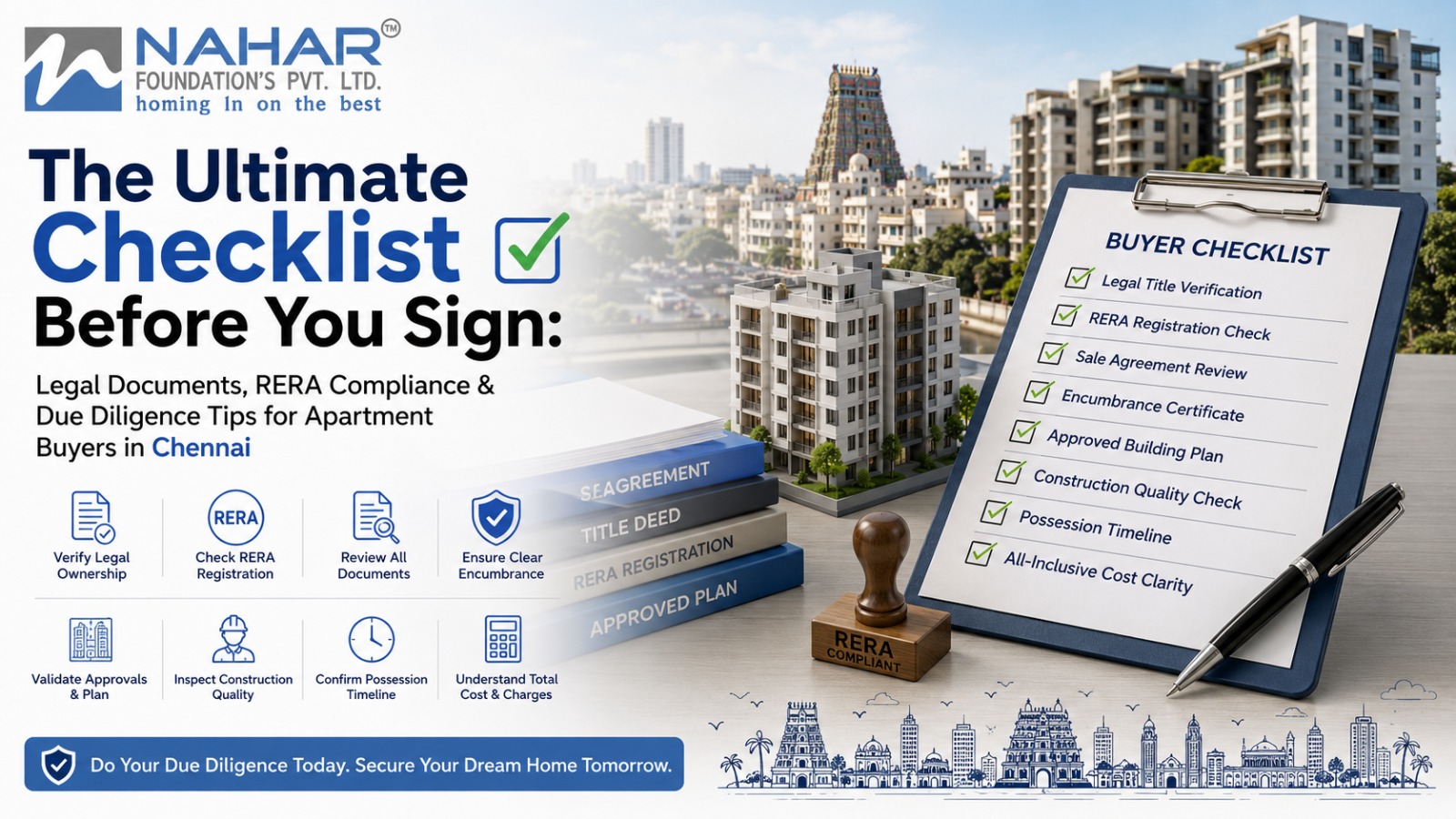
The Ultimate Checklist Before You Sign: Legal Documents, RERA Compliance & Due Diligence Tips for Apartment Buyers in Chennai
```html
There are dozens of choices that have to be made over the course of weeks or months when you're buying an apartment, such as where the apartment is, which direction it faces, how the rooms are arranged, how you're going to finance the purchase, what the interiors look like, etc. But it all comes down to one final critical moment, the moment when you enter into legal paperwork that has the potential of binding you to a deal that could last for many years, and that could cost you a significant portion of your earnings. It is a time that most buyers don't prepare the same way that it merits.
In recent years, the real estate market in Chennai has become much more regulated and consumer friendly, further enhancing consumer grievance redressal mechanisms after the implementation of RERA. However, even in this better environment, buyers who do not conduct adequate due diligence are still at risk of problems that can create small to significant problems, and even legal issues. The great thing is that no legal skills are necessary to protect yourself; a systematic approach, the right questions and a willingness to use a bit of time when things don't seem to be 100% clear.
The Foundation of Every Safe Property Purchase
The most basic question with any real estate transaction is seemingly simple – can the seller sell you this property without any encumbrance? In reality it's not possible to know the answer to this question with absolute certainty without looking at the title chain, or the historical record of the transactions of ownership that passed through the hands of the owner over at least the last 30 years and preferably further.
The qualified property lawyer engaged to do the title due diligence will inspect the original sale deeds, partition deeds, gift deeds, inheritance documents or court decrees by which each land owner transferred the land to the next. A missing link in the chain will be a problem in your estate title, as will be a deed from someone who didn't have the authority to sign it, or a period of uncertainty.
An encumbrance certificate issued from the Sub-Registrar's office give a chronological information of all the transactions which are registered against the property during a particular period. A positive encumbrance certificate listing no mortgage, lien or litigation registered at the property during the period covered by the search is important, but note that this cannot replace a thorough title search by the professional.
RERA Registration and What It Actually Protects
The Real Estate (Regulation and Development) Act has dramatically changed the power dynamics between developers and homebuyers in India and in most states, the act has ushered in a welcome amount of accountability in Chennai's residential property market. The RERA registration for a project is not just a checkbox item for apartment buyers, it's a set of protections that influence the rights of an apartment buyer throughout the process of buying an apartment.
All RERA registered projects are displayed on the TNRERA portal with the following information verified with the promoter: Approved Layout plan, sanctioned number of flats, project completion date, promoter's experience and the escrow account where the customer must pay for the property. You can check this information for yourself and save a bunch of minutes and you will get a great deal of reassurance other than just the developer's word.
The escrow requirement is important, especially. RERA requires the 70% of the money collected from purchasers to be placed in a separate project escrow account that is specifically for the project's construction and land costs. This rule directly tackles the pre-RERA practice of the diversion of funds to various projects by the buyers, which was one of the main reasons for delayed and stalled deliveries. With a RERA compliant project you are making payments that are legally ring-fenced and in no way possible as it were in pre-RERA transactions.
The Sale Agreement: Every Clause Demands a Reading
The sale agreement or agreement for sale, is the agreement that will regulate your relationship with the developer from the booking until you take possession of the property. It's a contract that's binding and putting it aside because you're too excited to sign it quickly when you've just found a property may have dire consequences further down the line.
The use of force majeure clauses to release the developer from the duty to pay for delays due to “any circumstances whatsoever” has been increasing in recent years of the post-pandemic era. Be able to describe exactly what the clauses address and if they are time limited or open-ended. Balanced penalties, in which interest is levied on late payments of the buyers, but also on late delivery of the developer, are fairly drafted. Clauses requiring a buyer to pay a penalty for delay – but not a significant amount – when a developer is late certainly need to be negotiated prior to signing.
Statutory Approvals That Must Exist Before Construction and Sale
For any apartment to be legally sound for the purchase, it should have all the necessary statutory approvals through each stage of the purchase. The approvals are different in Chennai, depending on the project location whether it is within CMDA jurisdiction (over the Chennai Metropolitan Area) or DTCP jurisdiction (beyond the limit of the Chennai Metropolitan Area).
Building plan approval, issued by CMDA or DTCP as appropriate, will indicate if the proposed building meets all the relevant zoning requirements, floor space index limits, setback requirements and land use. The approved plan must be confirmed with the buyer to ensure that the plan being built is the same. The risk of legal issues coming from deviation from the approved plan to actual construction is inherent in both the security of ownership of the buyer and whether the project will be eligible for an Occupancy Certificate at the time of its completion.
Possession, Handover, and What Happens on That Final Day
The possession process is the culmination of all the above and should be treated as such and given the same attention as the original agreement signing. Prior to taking over the apartment and signing the paperwork for the handover, do a comprehensive physical check of the apartment, using the specification schedule in your sale agreement.
Inspect all fixtures, fittings and finishes to ensure they meet the guarantee. Make a note of any difference on the same day in front of the developer's representative. Good developers pay attention to these snag lists; it's a commitment to good development and to the quality they offer, and Nahar Foundations' handover process involves a well-structured walkthrough of the site where that last quality standard is one of several key elements.